

You’ve added basic schema markup to your website, but your pages still don’t appear in rich snippets. Your competitors seem to dominate those eye-catching search results whilst your content remains invisible.
This frustrating situation happens because basic schema implementations work in isolation, missing the powerful connections that search engines crave.
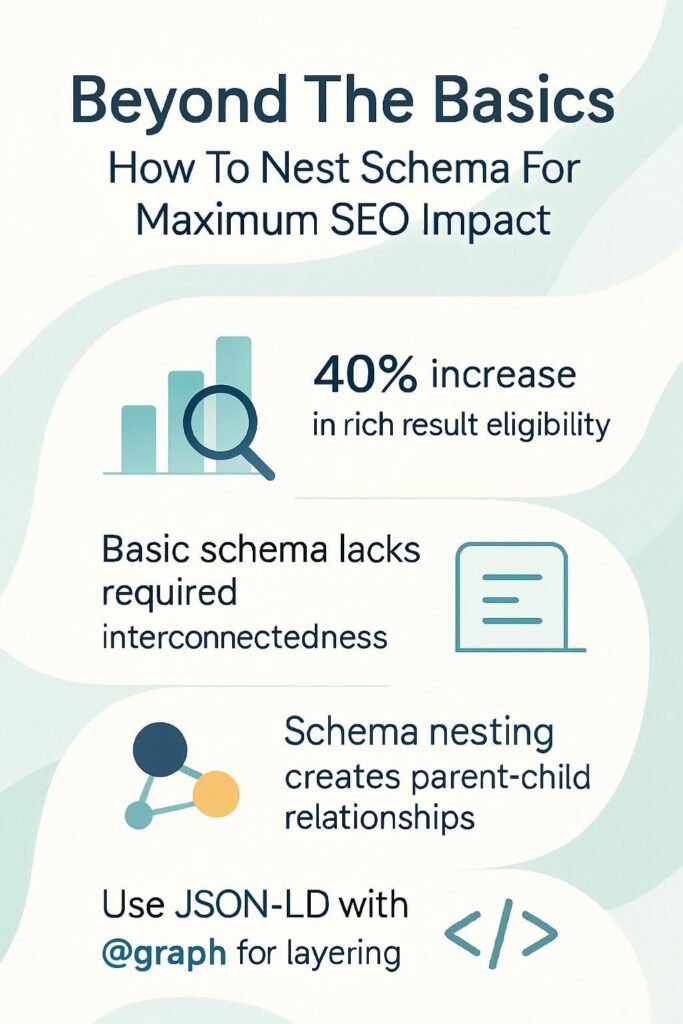
After working with hundreds of client websites over two decades, I’ve encountered this exact challenge countless times. Sites with layered schema implementations can yield a 40% increase in rich result eligibility compared to isolated schema setups.
Through extensive testing and research, I’ve discovered that modern search engines value interconnected schema over standalone implementations.
This guide reveals how to nest multiple schema types together for maximum SEO impact. You’ll learn to create semantic connections that search engines love, implement advanced layering techniques, and transform your basic markup into a powerful visibility machine.
Your schema strategy is about to level up significantly.
Key Takeaways
- Layered schema implementations yield 40% increase in rich result eligibility compared to isolated schema setups on websites.
- Rich results provide 20-30% improvement over standard links in click-through rates and user engagement metrics.
- The @graph architecture consolidates multiple schema types within single script tags for more efficient search engine processing.
- Entity-based schema architecture creates scalable networks connecting people, places, organisations, and concepts through meaningful relationships.
- AI-driven search features and voice search technologies will require different schema strategies compared to text-based queries.
Why does basic schema limit your SEO potential?
Most website owners start with basic schema markup, thinking it’s enough to boost their search visibility. Through my years of working with SchemaGenix.com, I’ve discovered that single schema implementations create a shallow understanding for search engines.
Basic structured data lacks the depth needed for search engines to fully understand your content, limiting its impact on SEO performance.
Standard schema markup fails to leverage the potential for rich results, which can significantly increase click-through rates and user engagement. Rich results provide a 20-30% improvement over standard links in terms of CTR.
Basic implementations may hinder visibility and performance as search engines develop comprehensive understanding of website content. Schema drift becomes a real problem with simple setups, undermining sustained SEO benefits over time.
Understanding schema nesting concepts
Schema nesting transforms your basic markup into a powerful web of connected information that search engines love. I’ve discovered that most website owners miss this goldmine because they stick to simple, isolated schema types instead of creating rich, interconnected data structures.
What is semantic nesting in schema?
Semantic nesting in schema markup creates hierarchically structured entities with definitive parent-child relationships. Think of it like a family tree for your website’s content. The main entity sits at the top, while related entities branch out below it.
This approach establishes meaningful connections between different pieces of information on your page. Google’s crawlers can then understand which content matters most and how everything fits together.
Nesting involves embedding one structured data object within another to define relationships between entities. For example, a restaurant’s main entity might contain nested entities for its menu items, reviews, and location details.
This creates a knowledge graph that helps Googlebot grasp priorities and hierarchy within the information presented. The structured approach transforms scattered content into organised, interconnected data that search engines can easily interpret and display in rich results.
How does the @graph architecture work in schema?
Building on semantic nesting principles, the @graph architecture takes structured data organisation to the next level. This powerful framework consolidates multiple schema types within a single script tag, creating a streamlined approach that search engines process more efficiently.
The @graph function works like a container that holds different schema types together in one organised package. Instead of scattered script tags cluttering your page, this architecture bundles everything into a neat array structure.
For example, Article schema with an ID and headline sits alongside FAQPage schema with its own ID and main entities, while BreadcrumbList schema adds its structured item list, all within the same @graph container.
This JSONLD approach transforms how search engines interpret your structured data, making the knowledge graph connections clearer and processing faster.
Advanced schema types for layering
I’ve discovered that layering advanced schema types creates a web of interconnected data that search engines absolutely love. Think of it like building a digital map where each schema type connects to others, forming a comprehensive picture of your content that goes far beyond basic markup.
What is How-To schema and how to use it?
How-To schema represents a powerful structured data format that transforms instructional content into search engine gold. This advanced schema type tells Google exactly what your step-by-step guides contain, making your content eligible for rich results that can boost visibility by up to 40%.
I’ve watched countless websites jump from page two to featured snippets simply by implementing this schema correctly.
Setting up How-To schema requires JSONLD markup that outlines each instruction step with clear descriptions and optional images. The beauty lies in its nesting capabilities, where you can combine How-To schema with FAQ schema using the hasPart property.
My agency recently helped a cooking blog integrate both schema types, and their recipe pages now dominate Google’s rich results. The @graph function becomes your best mate here, allowing multiple schema types to work together in one script tag without conflicts.
How can FAQ schema improve SEO?
While How-To schema guides users through processes, FAQ schema tackles a different challenge by directly answering the questions your audience asks most. FAQ schema transforms your content into rich snippets that appear prominently in search engine results pages, giving your website prime real estate above traditional listings.
Google has become more selective about displaying FAQ rich results, making proper integration of schema markup more crucial than ever for maintaining competitive advantage.
FAQ schema boosts your clickthrough rate by presenting structured questions and answers directly in search results, eliminating the guesswork for searchers. Voice search queries benefit tremendously from FAQ markup since virtual assistants pull answers from well-structured data to respond to spoken questions.
Featured snippets frequently source content from pages with properly implemented FAQ schema, positioning your website as the authoritative answer source. AI-generated overviews now rely heavily on structured data to compile comprehensive responses, making FAQ schema essential for visibility in Google’s evolving search landscape.
Why use Breadcrumb schema on your site?
Moving beyond FAQ schema, breadcrumb schema serves as your site’s digital map for both users and search engines. I implement BreadcrumbList schema on complex sites because it dramatically improves how Google understands inter-page relationships and content indexing.
Sites with multiple navigation paths benefit most from this approach. Dynamic categories and pages belonging in multiple sections create confusion without proper breadcrumb markup.
Breadcrumb schema becomes vital for website structure clarity and user experience enhancement. Search engines crawl more efficiently through sites with clear navigation hierarchies.
This markup increases visibility in AI search results by showing Google exactly how pages connect within your site architecture. Complex websites see improved content rankings because search engines can better comprehend the logical flow between related pages.
Strategies for effective schema nesting
Mastering schema nesting strategies can transform your website from a basic player into an SEO powerhouse that search engines can’t ignore.
How to integrate multiple schema types seamlessly?
I combine different schema types by embedding one within another to create richer structured data. This nested approach works like building blocks, where each schema type adds another layer of meaning to your content.
For example, I embed FAQ schema within How-To schema to create comprehensive markup that covers both instructional content and common questions. This combination delivers enhanced rich snippets that stand out in search results.
JSON-LD makes this integration process straightforward through its dynamic capabilities. The format allows seamless updates without touching your HTML code. I use the @graph architecture to connect multiple schema types through @id references, creating a web of related entities.
Manual verification of these @id connections becomes essential for proper integration, as automated tools sometimes miss semantic relationships between different markup types. This foundation sets the stage for understanding entity-based schema architecture and its scalable benefits.
What is entity-based schema architecture and why is it scalable?
Entity-based schema architecture transforms how I structure website data by creating meaningful relationships between real-world entities. This approach builds a comprehensive network where each piece of content connects to specific people, places, organisations, and concepts.
Instead of marking up isolated pages, I create a semantically rich web of information that search engines can understand and navigate. The architecture focuses on defining primary entities, establishing clear relationships using schema properties, and connecting everything to external authorities through sameAs properties.
Scalability becomes the architecture’s greatest strength because it grows naturally with your content strategy. Manual schema markup curation allows me to build comprehensive topical maps that expand across related subjects and industries.
The system adapts as you add new content, products, or services because each entity can connect to multiple others through various relationship types. This approach captures a wider range of search opportunities by aligning your entire website content strategy with entity bases.
The knowledge graph structure means adding one new entity automatically creates multiple connection points throughout your existing schema network.
Now let’s explore the advanced techniques that make FAQ schema work harder for your specific audience needs.
Advanced techniques for specific schema types
I’ve discovered that mastering specific schema types can transform your website’s search performance from ordinary to extraordinary.
How to optimise FAQ schema for user intent?
FAQ schema optimisation starts with understanding what your audience actually searches for. I focus on mapping frequently asked questions to specific user queries that drive traffic to my clients’ websites.
Search intent analysis reveals the difference between someone asking “how much does SEO cost” versus “why is SEO expensive”. Each question targets different stages of the customer journey.
Voice search optimisation demands conversational tone in FAQ answers. People speak differently than they type. Schema markup for FAQs must capture this natural language pattern.
Structured data works best when FAQ answers address customer objections directly. Cost concerns, implementation timeframes, and competitive advantages make powerful FAQ topics. Complete answers prevent users from bouncing to competitors.
Information architecture improves when FAQs nest within Article or WebPage schemas using the hasPart property. This connection boosts topical authority while improving featured snippet chances.
Content relevance increases when main page topics connect seamlessly with FAQ sections through proper schema nesting.
How to implement breadcrumb schema for complex websites?
Complex websites need dynamic breadcrumb schema that adapts to user paths while staying consistent for search engines. I generate breadcrumbs server-side using session data and referrer information to track entry points across the site hierarchy.
JSON-LD works best here because it allows conditional logic based on how visitors navigate through different sections. The schema must include the complete navigation structure even when mobile displays show truncated breadcrumbs.
Caching common navigation paths boosts performance while maintaining crawl optimisation for search engines. Dynamic content requires a canonical breadcrumb path that Google can follow consistently, regardless of how users actually move through the website hierarchy.
This approach helps search engines understand the structured data better and improves crawling frequency of important pages. Mobile responsiveness becomes critical since the complete schema markup must always be present even when the visual breadcrumbs appear shortened on smaller screens.
FAQ schema presents another powerful opportunity to capture user intent and boost search visibility.
Tools and best practices for schema validation
Testing your schema markup properly can make or break your SEO efforts, and I’ll show you the exact tools that separate amateur implementations from professional-grade structured data that search engines actually trust.
How to use the Schema.org Validator?
The Schema.org Validator acts as your quality control checkpoint for structured data implementation. I use this validation tool daily to verify schema markup before publishing any website changes.
The validator checks your code against official schema.org standards and flags errors that could prevent search engines from understanding your content properly.
Copy your schema markup code and paste it directly into the validator’s input field. The tool processes JSON-LD, Microdata, and RDFa formats with equal precision. Green checkmarks indicate successful validation, while red error messages highlight specific issues that need fixing.
Manual schema markup curation builds comprehensive topical maps and networks, making this validation step critical for maintaining code quality across your entire website structure.
How to test schema with Google Rich Results Tool?
After validating your structured data with Schema.org’s validator, I test my pages with Google’s Rich Results Tool for real-world performance. This tool assesses if a URL supports rich results and shows exactly what Google sees on your webpage.
I input my URL into the Google Rich Results Tool to check its capability for rich results. The tool evaluates publicly accessible webpages for possible rich results based on structured data markup.
Testing can be conducted using the Google Inspection Tool for both smartphone and desktop versions. This gives me a clear picture of how my schema markup performs across different devices and helps identify any issues that might prevent rich snippets from appearing in search results.
Future-proofing your schema strategy
Schema markup will evolve rapidly as AI and machine learning reshape search engines, so I’ll show you how to build flexible structured data systems that adapt to future algorithm changes while maintaining your competitive edge.
What schema trends should you prepare for in 2025?
AI-driven search features will change how Google processes structured data in 2025. Voice and visual search technologies need different schema strategies compared to text-based queries.
Entity authority will become more important than keyword optimisation as search engines focus on semantic relationships. Personalised search results will use entity connections to deliver customised content experiences.
Multilingual entity relationships need careful planning as global search becomes more advanced.
Layered schemas like How-To, FAQ, and Breadcrumb types create semantic foundations that adapt to changing Google algorithms. Knowledge graph integration will prioritise comprehensive schema data over basic markup implementations.
Digital marketing strategies must consider AI tools that automatically generate and validate structured data. The move towards entity recognition means websites need deeper semantic markup beyond simple product or article schemas.
How can AI tools help automate schema?
AI technology transforms how I create structured data for websites. These tools analyse content automatically and generate proper schema markup within minutes. Manual schema creation takes hours, but AI automation delivers the same results in seconds.
Businesses using AI-generated structured data report significant boosts in web traffic and engagement across their digital marketing campaigns.
Smart automation streamlines the entire process of schema creation. AI tools identify content types on your site and match them with appropriate markup. The system validates generated code against Schema.org standards before implementation.
This approach saves time while improving search engine optimisation results. Website owners can focus on content creation while AI handles the technical aspects of structured data implementation.
Conclusion
Schema nesting transforms your website from a collection of pages into a connected knowledge system. Your search rankings will improve when search engines understand the relationships between your content pieces.
Start with simple combinations like FAQ and Article schemas, then build complexity as you gain confidence. The 40% increase in rich result eligibility makes this effort worthwhile for any serious website owner.
Master these techniques now, and your site will stand out in an increasingly competitive digital landscape.
FAQs
1. What exactly is nested schema markup and why should I bother with it?
Nested schema is like Russian dolls for your website code. You stack different schema types inside each other to give search engines a complete picture of your content. This approach helps Google understand complex relationships between your page elements, which can boost your search rankings significantly.
2. How do I implement nested schema without breaking my site?
Start small with basic schema types, then gradually add nested layers. Test each addition using Google’s Rich Results Test tool before going live. Most content management systems handle the heavy lifting, so you won’t need to become a coding wizard overnight.
3. Which schema combinations work best for maximum SEO impact?
Product schema nested with Review and Organisation schema creates powerful results for e-commerce sites. Article schema combined with Author and Publisher markup works brilliantly for content sites. The key is matching your nested structure to what your audience actually searches for.
4. Can nested schema actually hurt my SEO if I mess it up?
Poorly implemented nested schema won’t tank your rankings, but it might prevent you from getting rich snippets. Google simply ignores broken markup rather than penalising your site. However, conflicting or irrelevant nested schema can confuse search engines and waste your efforts.