

Google’s search algorithm keeps shifting, and heaps of website owners find it tough to prove their credibility online. This challenge hits close to home because I’ve spent years helping clients improve their search rankings, and Google mentions trust 172 times in their Quality Rating Guidelines.
This guide shares practical strategies using E-A-T principles and schema markup to build authority and boost your search presence. Ready to become Google’s trusted expert?
Key Takeaways
- Google’s E-E-A-T framework expanded in December 2022 to include Experience, with trust mentioned 172 times in Quality Rating Guidelines.
- Schema markup acts as your website’s digital ID card, helping search engines understand your expertise through structured data like author and organisation details.
- YMYL content faces stricter scrutiny from Google’s quality systems, requiring stronger expertise signals for finance, health, and legal topics.
- Website speed directly impacts conversions, with Walmart gaining 2% conversion increases for every second of load time improvement achieved.
- High-quality backlinks from authoritative sites serve as the strongest trust signals, with proximity to trusted seed sites boosting PageRank authority.
What Are E-A-T and E-E-A-T?
Google’s E-A-T framework stands for Expertise, Authoritativeness, and Trustworthiness – three pillars that determine how search engines evaluate your content’s credibility. In 2022, Google expanded this to E-E-A-T by adding Experience, recognising that first-hand knowledge often trumps theoretical understanding in many fields.
What Does E-A-T Mean?
E-A-T stands for Expertise, Authority, and Trustworthiness. These three pillars form the foundation of how Google evaluates content quality and credibility. Through my work at SchemaGenix, I’ve applied these principles to many websites, helping clients build stronger search presence by demonstrating their expertise in their respective fields.
Google updated this framework on 22 December 2022, adding “Experience” to create E-E-A-T. This addition recognises that direct experience often matters as much as formal qualifications.
Content creators who have actually used products, visited locations, or lived through experiences can provide valuable insights that purely academic knowledge might miss.
Why Was “Experience” Added to E-E-A-T?
Google’s E-A-T framework evolved into E-E-A-T on 22 December 2022, just weeks after ChatGPT launched in November 2022. This timing wasn’t coincidental. The search giant recognised a massive shift coming in digital content creation.
AI-generated content is predicted to make up 90% of all content by 2026. Google needed a way to distinguish authentic, human-created content from automated outputs.
Experience now sits as the first “E” in E-E-A-T, highlighting its critical importance. This addition focuses on authenticity and practical knowledge gained through real-life situations.
While expertise covers qualified advice and formal credentials, experience emphasises lived encounters and hands-on learning. Google wants content creators to share genuine case studies and real-world examples rather than purely theoretical knowledge.
The company updates its E-E-A-T guidance annually to keep pace with evolving digital realities, and this latest change reflects their commitment to maintaining content quality in an AI-dominated landscape.
Why Is E-A-T Important for SEO?
E-A-T sits at the core of Google’s quality assessment process, directly influencing how your website performs in search results. Your site’s expertise, authoritativeness, and trustworthiness signals determine whether Google considers you worthy of ranking above competitors in your niche.
How Does E-A-T Affect Google Rankings?
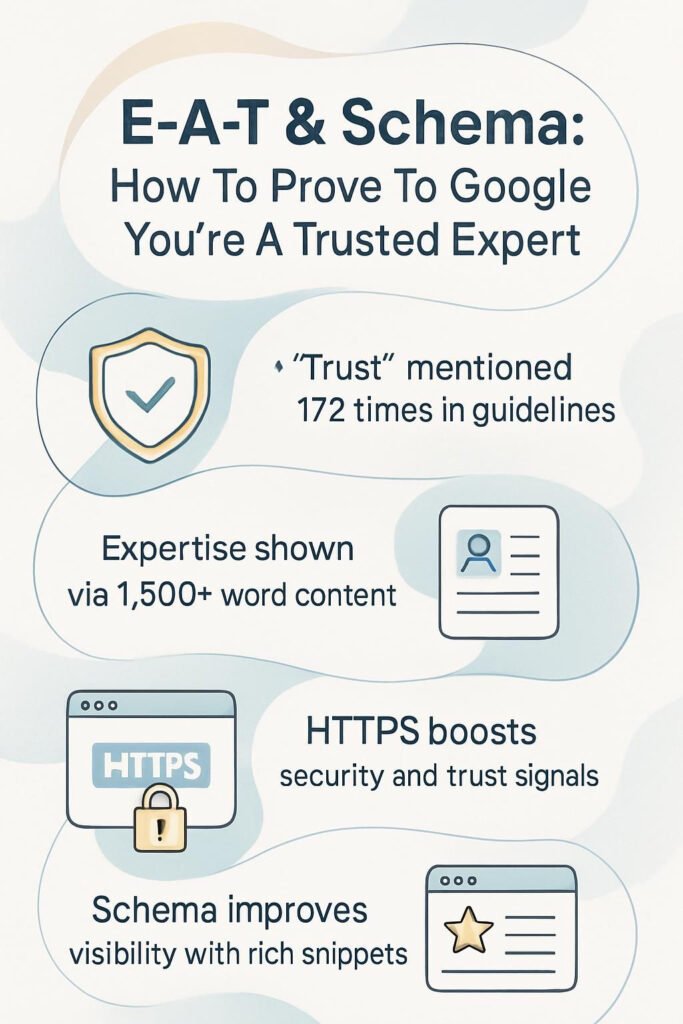
Google’s Quality Rater Guidelines reference “trust” 172 times, which shows how much weight Google places on trustworthiness for search rankings. Through my work with hundreds of websites at SchemaGenix, I’ve observed that sites with strong expertise, authoritativeness, and trustworthiness consistently outperform competitors in search results.
Quality raters assess these factors on a spectrum from lowest to highest, directly influencing ranking potential. Google’s PageRank algorithm evaluates importance by measuring proximity to trusted “seed sites” through backlinks, making authority a crucial ranking component.
Sites with poor trust signals face significant ranking challenges. HTTPS implementation serves as both a direct ranking factor and trust signal since Google prioritised secure connections.
Mobile-friendliness has influenced rankings since 2016, while site speed improvements can boost conversion rates by 2% for each second gained, as Walmart’s data demonstrates. Google’s natural language processing can detect negative sentiment, which damages perceived expertise and subsequently harms rankings.
Anchor text relevance from quality backlinks provides both trust and expertise signals that Google’s algorithms actively use for ranking decisions.
Moving beyond ranking impacts, understanding why these factors matter specifically for SEO success becomes essential for website owners.
Why Does E-A-T Matter for YMYL Content?
While E-A-T influences all content types, YMYL “Your Money or Your Life” topics face much stricter scrutiny from Google’s quality assessment systems. YMYL content covers areas that directly impact people’s financial wellbeing, health information, and legal advice decisions.
I’ve worked with clients in finance and healthcare sectors who discovered that poor content reliability can devastate their search visibility overnight.
Google’s Quality Rating Guidelines specifically state that even experienced creators behind financial scam sites receive low E-E-A-T classifications due to trustworthiness issues. The search engine treats YMYL industries like finance, health, and legal services with extra caution because misleading information in these areas can cause real harm to users’ lives and livelihoods.
Understanding Schema Markup and Its Role in E-A-T
Schema markup acts as your website’s digital ID card, telling Google exactly who you are and what you do. When you combine schema with strong E-A-T signals, you create a powerful foundation that helps search engines understand your credibility and expertise.
What Is Schema Markup?
Schema markup acts as a translator between your website content and search engines. This structured data vocabulary helps Google, Bing, and other search engines understand exactly what your web content means.
Think of it as adding labels to everything on your website, much like organising files in clearly marked folders.
Structured data uses a specific markup language called JSON-LD to communicate with search engines. Your website gains rich snippets in search results when you implement this code correctly.
These enhanced listings often display star ratings, business hours, or FAQ answers directly in Google’s search results. The knowledge graph benefits from this information, which can boost your site’s visibility and click-through rates significantly.
How Does Schema Support E-A-T Signals?
Schema markup acts as a direct communication channel between your website and Google’s crawlers. Through my years managing SEO campaigns, I’ve witnessed how structured data transforms vague content signals into crystal-clear trust indicators.
Review and AggregateRating schema display star ratings and testimonials directly in search results, creating immediate trust signals for potential visitors. Organisation schema establishes your business legitimacy by connecting your brand to verified external profiles through sameAs properties.
Author bylines with proper schema markup represent one of the most quantifiable E-E-A-T targets you can implement. Sites like Healthline leverage editorial process schema to showcase their content review procedures, demonstrating how subject matter experts fact-check each article.
This structured approach helps search engines understand content relationships and strengthens your topical authority within specific niches. About-page schema increases your perceived legitimacy while clarifying your expertise areas for Google’s algorithms.
Key Elements of E-A-T
E-A-T forms the backbone of Google’s quality assessment framework, and mastering these three pillars can make or break your search rankings. Each element works together like gears in a well-oiled machine, creating a powerful signal that tells Google your content deserves the top spot.
What Is Expertise?
Expertise represents your depth of knowledge, qualifications, and relevant experience in a specific field. Google evaluates this independently for each topic you write about. Your medical expertise won’t automatically transfer to financial advice credibility.
Through my SEO agency work in Sydney, I’ve observed how Google assesses author competence differently across various subjects. Formal degrees aren’t always required, but you must demonstrate substantial subject knowledge through your content and background.
Quality content serves as your primary expertise signal to Google. Research-backed articles of at least 1,500 words, containing 2-3 quality links and expert quotes, showcase your mastery.
Publishing weekly posts consistently builds your authority over time. Google also considers user feedback and public recognition when evaluating your credibility. Author bios highlighting your qualifications, industry awards, and specialisation help establish your professional standing.
Guest posts on authority sites and citations from trusted sources further strengthen your expertise signals.
How Do You Define Authoritativeness?
Authoritativeness means recognition as a reliable source by users, peers, and external entities in your field. I define it as the digital equivalent of being the go-to expert that people naturally turn to for answers.
Backlinks from high-authority, relevant sources serve as the strongest authority signal in Google’s algorithms. Think of each quality backlink as a vote of confidence from another respected website.
Being cited as an expert in reputable sources dramatically increases your authority status. Press mentions and notable clients add significant weight to your site’s credibility. Law firms excel at displaying authority through comprehensive team pages that showcase credentials and achievements.
Wikipedia page presence demonstrates substantial authority, though it requires significant media coverage to achieve. Authority gets reinforced by positive user reviews on independent platforms, creating a cycle of trust and recognition.
The number and quality of referring domains, which you can track in tools like Ahrefs Site Explorer, often measure your site’s authority level. Building trustworthiness becomes the next crucial component of establishing your expertise.
What Does Trustworthiness Mean?
Trustworthiness stands as the foundation of E-E-A-T, earning 172 references in Google’s Quality Rater Guidelines. This makes it the most critical component for proving credibility to both users and search engines.
The trust emerges when experience, expertise, and authority combine to create reliability and authenticity. Through my years optimising websites, I’ve observed that Google treats trustworthiness as the cornerstone that validates all other E-E-A-T signals.
These signals begin with basic security measures like SSL certificates, which provide HTTPS encryption as a baseline requirement. Your business information must be prominent and accessible, including clear contact methods and physical addresses.
Privacy policies, terms of service, and compliance statements for GDPR or CCPA demonstrate accountability and transparency. Social proof through testimonials, case studies, and user-generated content builds reputation, while negative reviews can damage trust signals significantly.
Publishing core values, ethics, and mission statements enhances perceived integrity and legitimacy. Building expertise requires demonstrating your knowledge through high-quality content and proper credentials.
How Can You Demonstrate Expertise?
Demonstrating expertise isn’t just about claiming you know your stuff – it’s about proving it through every piece of content you create. Your expertise shines through when you back up claims with solid research, showcase real credentials, and cite sources that even your toughest critics would respect.
How to Publish High-Quality, Research-Backed Content?
Publishing high-quality, research-backed content requires strict editorial standards that rival major media outlets. I create content that meets a minimum of 1,500 words and includes 2-3 authoritative links from sources verified through Domain Authority scores and backlink profiles via tools like Ahrefs or SEMrush.
Each piece undergoes fact-checking by subject matter experts before publication, which builds credibility with both readers and search engines. Expert quotes strengthen the content’s authority while proper grammar accuracy becomes non-negotiable, using tools like Screaming Frog for quality control checks.
Content clusters work brilliantly for establishing topic authority across related subjects. Weekly publishing schedules maintain consistent subject presence, which Google recognises as a signal of active expertise.
The research process involves sourcing data from trusted publications, particularly those with high Domain Authority ratings. Knowledge clusters help organise content strategically, creating comprehensive coverage of specific topics that search engines value.
This systematic approach transforms websites into authoritative resources that competitors struggle to match, especially when combined with backlinks from highly authoritative sites like Search Engine Land for SEO-related topics.
How to Showcase Author Credentials and Expertise?
Creating quality content sets the foundation, but displaying your credentials and expertise takes your authority to the next level. Google evaluates author credibility independently for each topic, making it crucial to showcase relevant qualifications prominently.
Start by crafting a detailed author bio that highlights your professional qualifications, certifications, and industry accolades. Include specific achievements like awards, recognition, and publication history that relate directly to your content topics.
Add social links to verify your identity and build trust with both readers and search engines. Implement author schema markup for each writer to help Google understand your credentials better.
Guest appearances on reputable sites and podcasts boost your credibility significantly, so actively seek these opportunities to expand your online reputation within your field.
How to Use and Cite Credible Sources?
Selecting credible sources forms the backbone of demonstrating expertise online. I focus on original research, government publications, and established academic institutions when building content authority.
Quality sources possess high domain authority, strong backlink profiles, and proven track records in their fields. Medical websites like Healthline excel because they cite peer-reviewed studies and maintain strict editorial standards.
Proper citation builds trust with both readers and search engines. Link directly to the source material rather than secondary reports. Use at least 2-3 high-quality references in research-backed articles to meet Google’s standards.
Avoid “nofollow” tags on reputable source links, as these connections signal content quality to search algorithms. Trusted source popups can provide instant credibility verification for readers who want to verify claims quickly.
Building authoritativeness through strategic link placement becomes your next priority.
How to Build Authority for Your Website?
Building website authority is like constructing a digital reputation that speaks volumes before you even say a word – it’s about earning respect from both search engines and your audience through strategic partnerships, consistent brand presence, and media recognition that transforms your site from unknown to unmissable.
How to Acquire Backlinks from Authoritative Sites?
Backlinks from authoritative, relevant sources act as the strongest trust and authority signals in Google’s algorithms. I focus on building relationships with industry publications and respected websites that align with my niche.
Quality beats quantity every time. A single link from a high-domain authority site carries more weight than dozens from low-quality sources. The Link Graph concept shows how proximity to trusted “seed sites” increases authority through PageRank measurements.
Anchor text relevance in backlinks serves as an additional trust and authority signal that Google values highly. Guest posting on reputable industry blogs, creating valuable resources that others want to reference, and developing newsworthy content helps attract natural links.
Services like Linkifi can generate valuable backlinks from top industry publications when organic link building proves challenging. Every site page, including About, Careers, and Contact sections, presents link-building opportunities that many website owners overlook.
Building a strong digital brand presence becomes the foundation for sustainable link acquisition strategies.
How to Build a Strong Digital Brand Presence?
Building a strong digital brand presence requires strategic content creation that goes beyond basic marketing tactics. I’ve found that branded newsletters, similar to James Clear’s approach, create lasting trust with audiences while naturally attracting valuable links from other websites.
Career pages serve as powerful trust signals, even when companies aren’t actively hiring. Google’s careers section demonstrates this well, generating links while establishing corporate legitimacy.
Candy Funhouse took this concept further, creatively using their careers pages to acquire high-quality links through innovative content marketing.
Content in multiple languages significantly expands brand reach and builds trust across diverse markets, as Shopify has demonstrated through their global content strategy. Humanising your business through detailed team profiles and comprehensive About pages increases both trust and brand recall among visitors.
Publishing your company’s origin story creates differentiation and makes your brand more linkable, just like Chick-fil-A’s compelling narrative. Core values and mission statements enhance legitimacy while attracting natural links from organisations like the CDC and Spaceforce.
Netflix’s culture page stands as an excellent example for employer branding, strengthening overall digital brand perception through authentic storytelling. Building authority through link acquisition becomes the next crucial step in establishing your website’s credibility.
How to Engage with Press and Media?
A strong digital brand presence naturally leads to media opportunities. Press mentions significantly increase perceived authority and trust in your website.
I focus on creating editorial guidelines that mirror those of established media outlets. This approach increases credibility with journalists who appreciate professional standards.
Guest posts and podcasts expand your visibility within press circles. Participating in these formats builds relationships with media professionals. Community engagement through responding to press inquiries extends brand reach and authority.
I track the impact using Ahrefs Site Explorer to monitor referring domains and traffic from media coverage. Regularly updating a press or media page showcases coverage and awards. Notable client lists displayed on-site boost authority when journalists research your background.
Content promotion through targeted outreach connects you with relevant media contacts who cover your industry.
How Can You Strengthen Trustworthiness?
Trust acts as the foundation that holds your entire SEO strategy together. Building trustworthiness requires concrete actions that signal reliability to both Google and your website visitors.
Why Is HTTPS Important for Trust?
HTTPS acts as your website’s digital security guard. SSL certificates create data encryption that protects every piece of information flowing between your site and visitors. Google’s Quality Rater Guidelines specifically highlight HTTPS as a core trust indicator that directly impacts your search rankings.
Without this secure sockets layer protection, browsers display scary warning messages that instantly damage user confidence.
Your website’s trustworthiness takes a massive hit without HTTPS implementation. Modern users expect online security on every reputable site they visit. Privacy regulations like GDPR and CCPA require proper protection of sensitive information, making SSL certificates essential for compliance.
YMYL sites handling financial or health data face even stricter requirements. The lack of HTTPS can instantly lower your site’s E-E-A-T assessment, while proper implementation sends strong trust signals that boost both user experience and website ranking performance.
What Business Information Should You Include?
Your business information forms the backbone of trustworthiness and legitimacy online. I recommend including a complete contact page with your physical address, interactive map, phone number, and email address.
This transparency signals to Google that you operate a real business with genuine contactability.
Social media links across all your active platforms provide verification of your digital presence. A careers page demonstrates business stability, even when you’re not actively hiring.
Legal pages like privacy policies, cookie policies, and GDPR compliance (if applicable to your region) show professionalism. Your company’s origin story and mission statement on the About page creates authenticity while making your content more linkable.
Team profiles for senior members, accessible from your About page, put faces to your brand and strengthen credibility through individual expertise.
How to Add Reviews and Testimonials?
Customer feedback forms the backbone of online reputation management. I focus on collecting reviews across platforms where my target audience makes decisions. Local businesses need Google Business Profile reviews since 95% of customers read online reviews before making a purchase.
SaaS companies should prioritise G2 reviews, while e-commerce sites benefit most from TrustPilot ratings.
Automation makes review collection effortless and consistent. Setting up follow-up emails after purchase or service completion increases response rates significantly. Offering small incentives like discount codes can boost participation without compromising authenticity.
Display testimonials prominently on service pages where potential customers need trust signals most. Case studies provide deeper social proof than simple star ratings. User-generated content through community engagement and ambassador awards builds credibility naturally.
Implement AggregateRating schema markup to showcase satisfaction ratings directly in search results, giving potential customers immediate trust signals before they even visit the site.
Using Schema Markup to Enhance E-A-T
Schema markup acts as your website’s digital ID card, telling Google exactly who you are and what you do. I’ll show you how to implement specific schema types that directly boost your E-A-T signals and make search engines trust your content more.
How to Markup Author Information?
Author schema markup acts as your digital business card for Google’s algorithms. I implement Person schema for every author profile on client websites because it creates direct connections between content creators and their expertise.
This markup includes essential details like qualifications, awards, and public recognitions that Google uses to assess authoritativeness. Social media links and external citations within the schema boost credibility signals significantly.
Bylines paired with proper schema markup become quantifiable E-E-A-T targets that search engines can track and measure. Each article needs author bylines connected to comprehensive Person schema that references guest posts, podcast appearances, and professional achievements through sameAs properties.
Knowledge graphs pick up these structured data signals to build stronger digital reputation profiles. The markup increases content visibility in search results while establishing perceived expertise across multiple touchpoints.
How to Markup Organisation Details?
Organisation schema markup acts as your business’s digital identity card for Google. I include founding date, founders, physical address, and key affiliations to establish legitimacy.
The schema must connect to all relevant social channels through the sameAs property, creating a web of trust signals that search engines recognise.
About-page schema provides the perfect opportunity to showcase business mission, values, and company history through structured data. Contact pages and careers sections should be wrapped in organisation-level schema to demonstrate transparency.
Compliance statements like GDPR, CCPA, and DMCA policies can be marked up to show regulatory adherence. Company ethics and mission statements gain extra weight when properly structured, helping Google verify business trustworthiness and boost online visibility.
Next, let’s explore how FAQ and review markup can strengthen your site’s authority signals.
How to Markup FAQs and Reviews?
After setting up organisation details with structured data, FAQ and Review schema become your next powerful tools for building trust signals. FAQ schema helps you answer common user questions while showcasing topical authority.
Review schema surfaces independent feedback that builds credibility with potential customers.
I implement AggregateRating schema to display testimonials and star ratings in search results. Star ratings in SERPs can increase click-through rates and perceived trust significantly.
FAQ schema should focus on genuine buyer questions that demonstrate expertise in your field. Case studies marked up as reviews or testimonials create additional trust signals. Rich snippets from both schema types improve visibility while strengthening your online reputation.
Always use real, verified reviews in schema markup to avoid Google penalties, and update FAQs and reviews regularly to maintain accuracy across your content markup strategy.
Visit SchemaGenix for More on Enhancing E-A-T with Schema Markup
SchemaGenix offers comprehensive tools and guidance for implementing structured data that strengthens your E-A-T signals. The platform provides step-by-step instructions for creating Person Schema, Organisation Schema, Review Schema, and FAQ Schema markup.
These schema types help Google understand your expertise, authority, and trustworthiness more clearly. The site includes validation tools that check your structured data for errors before you publish it.
Case studies on SchemaGenix show how brands have improved their search visibility by using proper schema markup. The platform covers compliance-related schema for privacy policies and legal statements, which builds trust with both users and search engines.
You’ll find guidance on using sameAs schema to connect author profiles and business entities across different platforms. The resource also explains how schema markup works in AI-powered search results and zero-click searches.
Technical SEO strategies complement these schema implementations to create a complete E-A-T foundation.
Technical SEO Strategies for E-A-T
Technical SEO forms the backbone of your website’s credibility signals. A fast-loading site with clean code tells Google you care about user experience, which directly impacts your trustworthiness score.
How to Improve Website Speed and Mobile Experience?
Page load time directly impacts your bottom line. Walmart discovered that shaving just one second off their site speed boosted conversions by 2%. Through my years optimising websites for local businesses, I’ve watched countless clients lose customers to sluggish pages.
Google PageSpeed Insights serves as the gold standard for measuring website performance. Run your site through this tool and tackle the red flags first.
Mobile optimisation isn’t optional anymore. Google has treated mobile-friendliness as a ranking factor since 2016, and 53% of global website traffic now flows from mobile devices. Modern themes must be responsive by default.
Sites that fail mobile tests face penalties in both search engine ranking and user experience. Regular design refreshes maintain trust and prevent your site from looking outdated. Slow-loading, non-responsive sites get hammered by Google’s algorithms while driving away potential customers who won’t wait around.
Why Is Proper Site Architecture and Internal Linking Important?
Beyond optimising speed and mobile experience, website structure forms the backbone of your E-A-T success. Site architecture must be simple for efficient crawling, indexing, and navigation.
Poor navigation diminishes user confidence and trust, which directly impacts how Google perceives your expertise. From my experience working with hundreds of websites, a clean content hierarchy allows search engines to understand your topical authority better.
Internal links should illustrate topical relationships and support content clusters across your site. These connections show the depth and breadth of your knowledge on specific topics.
Link equity flows through your internal linking structure, strengthening authority signals throughout your website. All links must be visible and easily clickable for both users and crawlers to maintain trustworthiness.
Broken links damage your credibility, so fix them using WordPress Broken Link Checker or Ahrefs Free Broken Link Checker. Content interlinking demonstrates your comprehensive understanding of subjects, while outbound links should connect only to reputable, trustworthy sources.
How Often Should You Update Outdated Content?
I recommend updating your content based on its type and purpose. Breaking news articles need fresh information within hours or days of major developments. Product release pages require updates whenever new features launch or specifications change.
Annual list articles, like “Best Tools for 2024,” need complete refreshes every year to maintain their search engine optimisation value.
Your YMYL content demands the most attention for content management success. Medical advice, financial guidance, and safety information should undergo annual reviews at minimum. Tools like Screaming Frog help identify pages that haven’t been touched in months, making website audits more efficient.
Editorial process pages should display the last update date prominently, as this builds authority signals and shows Google your commitment to information credibility. Fresh content performs better in AI Overviews and zero-click searches, making regular content refresh essential for modern digital marketing strategies.
Best Practices for Building E-A-T
Building strong E-A-T requires consistent effort across multiple areas of your website and content strategy. I’ll share the most effective practices that have helped my clients establish themselves as trusted experts in their fields.
Why Create an Informative “About Us” Page?
Your “About Us” page acts as the foundation of your website’s trustworthiness. I’ve discovered through my SEO work that 100% of the top 20 sites for “purple mattress review” feature dedicated About pages, which speaks volumes about their importance for credibility.
This page gives visitors crucial details about your company profile and the people behind your brand.
A well-crafted About page should include your team introduction, showcasing senior members with their qualifications and expertise. Your brand story and mission statement help visitors connect with your purpose while building authority in your field.
I recommend adding testimonials and user-generated content to provide social proof that boosts perceived trustworthiness. Implementing organisation schema markup on this page can improve your search visibility and help Google understand your business better.
How Often Should You Publish Content?
It’s recommend publishing content at least once per week to maintain strong audience engagement and build brand authority. Consistency matters more than frequency when developing a solid content strategy.
Search engines favour websites that demonstrate regular publishing schedules over sporadic content dumps.
Quality content should always take priority over publishing frequency. A well-researched article published weekly will outperform three rushed pieces that lack depth. Focus on creating valuable content that serves the audience rather than chasing arbitrary publishing quotas.
This approach strengthens online presence while supporting long-term SEO practices and content management goals.
Why Use Original Images and Videos?
Original images and videos create authentic connections with your audience in ways stock photos can’t match. Custom imagery shows visitors you’ve invested time and effort into creating something just for them.
This personal approach increases trustworthiness, with 79% of consumers feeling more trust towards brands using custom visuals. Stock photos often appear on multiple websites, making your content look generic and potentially harming your credibility.
Visual content is a powerful quality assurance signal to both users and search engines. High-quality, original content is critical for building trustworthiness under Google’s E-E-A-T guidelines.
Custom videos and images show your commitment to providing valuable, direct information rather than recycled content. Search visibility improves when you create original visuals that complement your written content, as this combination enhances user engagement and time spent on your pages.
Content marketing becomes more effective when you control every aspect of your visual storytelling, allowing you to shape audience perception as you want it. Beyond visuals, I’ll explore the common pitfalls that can undermine your E-A-T efforts.
What Common Mistakes Should You Avoid?
Even seasoned website owners fall into traps that can sabotage their E-A-T efforts and tank their search rankings. Let me show you the most dangerous pitfalls and how to sidestep them completely.
Why Should You Not Overlook YMYL Guidelines?
YMYL (Your Money or Your Life) guidelines can make or break your search rankings if you operate in health, finance, or safety sectors. Google scrutinises these topics with laser focus because poor information can harm people’s wellbeing or financial security.
Untrustworthy pages receive low E-E-A-T scores regardless of how well-written the content appears.
Ignoring YMYL standards puts your website at serious risk of ranking penalties. Sites covering medical advice, investment tips, or legal guidance must demonstrate exceptional expertise through author credentials and factual accuracy.
Regular content updates and credible source citations become non-negotiable requirements for maintaining visibility in search results.
What Are the Risks of Using Unverified Information?
YMYL guidelines serve as your foundation, but unverified information can quickly tear down everything you’ve built. Misinformation spreads like wildfire across websites, and search engines have become incredibly sharp at spotting content that lacks proper verification.
Your credibility takes a massive hit each time you publish information without checking sources or confirming facts.
Unverified content creates a domino effect that damages your entire digital presence. Search engine rankings plummet because algorithms detect unreliable information and flag your site as untrustworthy.
User engagement drops significantly as visitors lose confidence in your expertise and authority. Your website becomes a liability rather than an asset, particularly dangerous for topics affecting user safety and wellbeing.
Why Is Updating Old Content Crucial?
Stale content kills your website’s credibility faster than you can say “outdated information.” Google’s Search Quality Rater Guidelines demand regular content refresh to maintain trustworthiness, and I’ve learned this lesson the hard way through years of SEO strategy work.
Fresh updates signal to search engines that you’re committed to information accuracy, which directly impacts your digital credibility. My experience optimising local SEO campaigns has shown me that websites with current content consistently outrank those with forgotten, dusty pages.
Content marketing success hinges on your ability to keep information current and relevant. Trust signals strengthen when you demonstrate ongoing expert validation through regular updates.
Quality assessment algorithms favour sites that show active maintenance, and this translates into better user engagement metrics. Authority building becomes much easier when your content reflects the latest industry developments and research findings.
How Does E-A-T Work in the Era of AI and Zero-Click Searches?
AI has changed how Google evaluates content quality and expertise. Search engines now prioritise content that demonstrates real experience and practical knowledge over generic information.
How to Align Content with Google’s Helpful Content System?
Google’s Helpful Content System rewards material that puts people first. I focus on creating content that directly answers user questions and solves real problems. The system evaluates whether content demonstrates genuine expertise and provides value beyond what already exists online.
Quality content should show effort, originality, and deep knowledge of the subject matter.
Search engines now prioritise content that satisfies search intent completely. My approach involves understanding what users actually want to know, then delivering comprehensive answers in accessible formats.
The system favours content that keeps readers engaged and encourages them to spend time on the page. Fresh content that gets regular updates signals to Google that the information stays current and relevant.
What Role Does AI Play in Evaluating E-A-T?
AI systems now analyse massive data sets to spot content quality indicators that match user intent in E-E-A-T evaluation. From my experience working with semantic search optimisation, these systems can process millions of web pages in seconds to identify patterns that signal expertise, authority, and trustworthiness.
Machine learning algorithms examine factors like content depth, source credibility, and information relevance to determine how well pages meet search quality standards.
The surge in AI-generated content has made demonstrating genuine E-E-A-T more critical than ever. Google’s Helpful Content System prioritises human-centric content over AI-driven pages that often lack personal experience and authentic insights.
Tools like Semrush’s Enterprise AIO help businesses track E-E-A-T improvements across various AI platforms, giving website owners concrete data about their progress. Implementing structured data and schema markup becomes vital here, as it helps search engines better understand your content’s context and boosts trust signals in E-E-A-T evaluations.
High E-E-A-T scores prove essential for maintaining visibility in zero-click searches, where AI systems decide which content deserves top placement without users clicking through to websites.
FAQs About E-A-T and Schema
You’ve probably got burning questions about E-A-T and schema markup swirling around your head right now. I’ll tackle the most common queries that website owners throw my way about proving expertise to Google’s algorithms.
Is E-A-T a Ranking Factor?
E-A-T doesn’t function as a direct ranking factor in Google’s algorithm. Google’s Quality Rating Guidelines emphasise trust as a significant factor in content assessment, but these guidelines train human evaluators rather than directly influence search rankings.
Through my work optimising websites for entity signals, I’ve observed that sites with strong expertise, authority, and reputation tend to perform better in search results. This correlation exists because Google’s systems have become sophisticated at identifying quality content that demonstrates these characteristics.
Trustworthiness stands as the most important aspect of E-E-A-T and can indirectly impact search rankings through various signals. Sites that build credibility through positive reviews, relevant backlinks, and high-quality content often see improved visibility.
The algorithm recognises patterns that align with trustworthy sources, such as proper citations, author credentials, and consistent user engagement. While Google doesn’t have an “E-A-T score,” the principles behind expertise, knowledgeability, and integrity shape how content gets evaluated and surfaced to users seeking reliable information.
What Role Does Schema Play in E-A-T?
Schema markup acts as your website’s digital ID card, telling Google exactly who you are and what you do. I’ve found that implementing structured data types like Organisation, Person, Article, and Review schema directly signals legitimacy and trust to search engines.
This markup language transforms your content into rich snippets that stand out in search results, boosting both visibility and credibility.
Schema’s sameAs property creates powerful trust signals by linking your organisation’s properties with social media profiles and official websites. Detailed author bylines with proper schema notation showcase content creators’ expertise, which positively impacts your E-E-A-T scores.
Reviews and testimonials using Review schema can display as rating stars in search results, immediately increasing user trust and engagement. The next step involves understanding how to demonstrate your expertise through high-quality, research-backed content.
How Does E-E-A-T Differ from E-A-T?
E-E-A-T includes “Experience” as an additional component that E-A-T lacks. Google added this fourth element to emphasise the value of first-hand lived experience in content evaluation.
This shift recognises that real-world experience often carries more weight than theoretical knowledge alone.
Trust remains the most critical element in both frameworks, but E-E-A-T places greater emphasis on demonstrating practical experience alongside expertise, authoritativeness, and trustworthiness.
Content creators now need to showcase their direct involvement or personal encounters with topics they write about. This change particularly impacts YMYL topics where lived experience can significantly influence user trust and engagement.
Conclusion
Building trust with Google isn’t rocket science, but it takes consistent effort and smart strategy. Schema markup acts as your website’s translator, helping search engines understand your expertise and credentials.
Quality content, proper technical setup, and transparent business practices work together like a well-oiled machine. Start implementing these E-E-A-T strategies today, and watch your search rankings climb steadily upward.
FAQs
1. What is E-A-T and why does Google care about it?
E-A-T stands for Expertise, Authoritativeness, and Trustworthiness. Google uses these signals to separate the wheat from the chaff when ranking websites. Your site needs to prove it knows its stuff, has credibility in its field, and won’t lead users down the garden path with dodgy information.
2. How does schema markup help prove my expertise to Google?
Schema markup acts like a translator between your content and Google’s crawlers. It tells search engines exactly what your content means and who created it. When you add author schema, organisation schema, and review markup, you’re basically giving Google a detailed CV of your credentials.
3. What specific schema types boost E-A-T signals most effectively?
Author schema, Organisation schema, and Review schema pack the biggest punch for E-A-T. Author schema showcases your credentials and expertise. Organisation schema establishes your business legitimacy. Review schema demonstrates social proof and trustworthiness from real customers.
4. Can small businesses compete with big brands using E-A-T and schema?
Absolutely, David can still beat Goliath in the digital world. Small businesses often have deeper expertise in niche areas and stronger local connections. By implementing proper schema markup and showcasing genuine expertise through detailed author bios, case studies, and customer testimonials, smaller players can outrank larger competitors who neglect these fundamentals.