

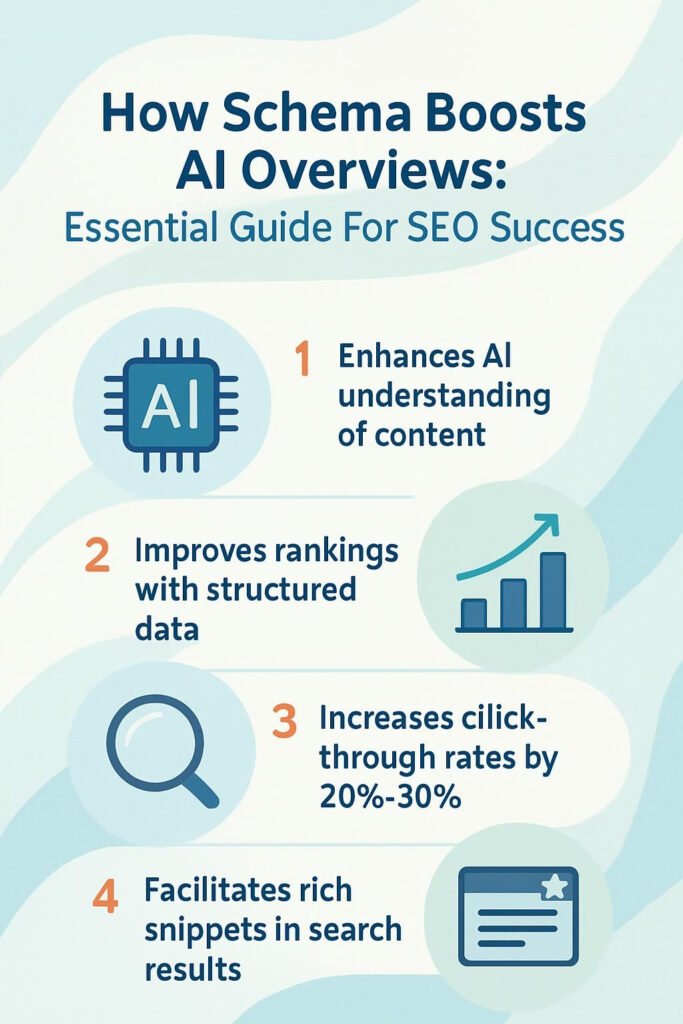
Website owners struggle to get their content featured in Google’s new AI Overviews, missing out on valuable search visibility. Websites using schema markup experienced a 30% increase in organic click-through rates compared to those without structured data.
This guide reveals how schema markup transforms ordinary content into AI-friendly information that search engines can easily understand and feature prominently. Get ready to boost your search rankings with proven schema strategies.
Key Takeaways
- Websites using schema markup experienced a 30% increase in organic click-through rates compared to those without structured data.
- FAQ, How-To, and Local Business schema types deliver the highest impact for appearing in Google’s AI Overviews.
- Schema markup acts as a translator between website content and AI systems, improving content parsing speed and accuracy.
- JSON-LD format provides the simplest method for implementing structured data without disrupting existing page content or design elements.
- Google Search Console’s Enhancement reports help monitor schema performance and identify errors that prevent AI engines from understanding content.
What exactly are AI overviews?
Understanding these advanced search features becomes crucial for website owners who want to maintain their competitive edge in search results. AI overviews represent Google’s latest evolution in presenting search results to users.
AI overviews are Google’s intelligent response boxes that appear at the top of search results pages. These AI-driven summaries pull information from multiple sources across the web to answer user queries directly.
Google’s artificial intelligence analyses content from various websites and creates comprehensive responses that save users time. The system selects the most relevant and authoritative information to display in these prominent positions.
Jeff Lee has observed through his 20 years of SEO experience that AI overviews significantly impact how users interact with search results. These overviews often reduce the need for users to click through to individual websites, making it essential for content creators to optimise their material for inclusion in these AI-generated responses.
How schema supports AI overviews
Schema markup provides search engines with structured data that makes content easier for AI systems to understand and process. This enhanced comprehension allows AI overviews to extract accurate information from websites and present it directly in search results.
How does schema improve AI content parsing?
Structured data transforms how artificial intelligence engines process website content by providing clear, machine-readable information. Search engines struggle to understand unstructured content, but schema markup creates a standardised format that AI systems can easily interpret.
This markup acts as a translator between human-readable content and machine understanding, allowing AI engines to quickly identify key elements like product prices, business hours, author credentials, and content relationships.
Google’s AI systems rely heavily on this structured information to generate accurate overviews and rich results for users.
Schema markup significantly enhances content parsing speed and accuracy for AI-driven search systems. Websites using schema markup experienced a 30% increase in organic click-through rates because AI engines can better understand and present their content in search results.
The markup eliminates guesswork for search algorithms by explicitly defining content types, relationships, and context through JSON-LD implementation. AI overviews depend on this clear data structure to extract relevant information and create comprehensive responses for user queries, making schema essential for modern SEO success.
What schema types matter for AI overviews?
Several schema types directly influence AI overviews performance. FAQ schema markup proves essential for websites targeting question-based searches, as AI engines frequently pull answers from structured FAQ content.
How-To schema helps websites capture step-by-step queries that users commonly ask AI systems. Local Business schema becomes critical for location-based searches, allowing AI to understand business details like opening hours, contact information, and services offered.
Product schema drives e-commerce visibility in AI-driven search results. Article schema helps news sites and blogs appear in AI overviews for informational queries. Jeff Lee’s experience implementing JSON-LD schema on hundreds of sites shows that Review schema significantly improves trust signals for AI engines.
Organisation schema establishes entity relationships that AI systems use to build comprehensive overviews. These specific schema types create the structured foundation that allows search engines to easily understand website information, directly supporting the 30% increase in organic click-through rates that websites experience when using proper schema markup.
What are the benefits of using schema for AI overviews?
Schema markup provides website owners with three significant advantages when targeting AI overviews in search results. These benefits directly impact search visibility, user engagement, and content comprehension by artificial intelligence systems.
How does schema increase search visibility?
Structured data markup acts as a translator between website content and search engines, making information crystal clear for AI systems to process. Search engines can easily understand the information on a website through proper schema implementation, which directly leads to enhanced visibility in search results.
Websites using schema markup experienced a 30% increase in organic click-through rates, proving its effectiveness in boosting online presence.
Rich results become more accessible when search engines comprehend content structure through markup. Schema markup increases the chances of content appearing in rich results like featured snippets, knowledge panels, and carousels.
These enhanced search features occupy prime real estate on search engine results pages, giving websites significant competitive advantages over competitors without proper structured data implementation.
How can schema improve click-through rates?
Schema markup creates visually appealing search results that grab users’ attention immediately. Websites using schema markup experienced a 30% increase in organic click-through rates, making this structured data approach highly effective for boosting user engagement.
Rich snippets display additional information like star ratings, prices, cooking times, or event dates directly in search results. These enhanced listings stand out from standard blue links and provide users with valuable details before they click.
Jeff Lee from SchemaGenix has observed that clients implementing proper schema markup see dramatic improvements in their search performance metrics. The enhanced search listings created by schema markup give users more confidence to click through to websites.
Search engines display schema-enhanced results with eye-catching elements such as review stars, product images, FAQ sections, and business hours. This visual enhancement makes listings more trustworthy and informative, leading users to choose schema-optimised results over plain text alternatives that lack these compelling visual elements.
How does schema enhance AI content understanding?
Structured data acts as a translator between website content and artificial intelligence systems. Search engines use this markup to decode complex information quickly and accurately.
AI algorithms process schema markup to identify key elements like product details, business hours, and review ratings. This structured approach helps AI systems categorise content more effectively than parsing raw HTML text.
Website owners who implement schema markup provide clear signals about their content’s meaning and context. The markup transforms unstructured text into organised data that AI engines can interpret with greater precision.
Google’s AI systems rely on this structured information to generate comprehensive overviews and featured snippets. Websites using schema markup experienced a 30% increase in organic click-through rates, demonstrating the direct impact on search performance.
Moving forward, understanding which specific schema types deliver the strongest results becomes crucial for maximising AI overview opportunities.
How to optimise schema for AI overviews
Schema optimisation for AI overviews requires strategic implementation of structured data markup that search engines can easily interpret and display in their AI-generated responses.
How do you implement JSON-LD markup?
JSON-LD markup provides the simplest method for implementing structured data on websites. Website owners can add this code directly to their HTML head section without disrupting existing page content or design elements.
JSON-LD stands for JavaScript Object Notation for Linked Data, and it allows search engines to easily understand the information on a website through clean, readable code blocks.
Implementation requires placing the structured data between script tags with the type “application/ld+json” attribute. Website owners can generate this markup using free advanced schema generators or create it manually by following schema.org guidelines.
The markup should include relevant properties like name, description, URL, and other specific details that help AI engines understand website content more effectively, increasing the chances of appearing in rich results and improving organic click-through rates.
Why prioritise FAQ, How-To, and Local Business schema?
FAQ, How-To, and Local Business schema types deliver the highest impact for AI overviews because they directly answer user questions and provide clear, structured information. These schema formats help AI engines understand website content more effectively, making it easier for search algorithms to extract relevant data for featured snippets and knowledge panels.
FAQ schema organises questions and answers in a format that matches natural search queries, while How-To schema breaks down processes into digestible steps that AI systems can easily parse and present to users.
Local Business schema proves particularly valuable for businesses targeting geographic markets, as it provides essential information like opening hours, contact details, and location data that AI overviews frequently display.
Google’s AI systems prioritise content with clear structure and authoritative information, which these three schema types provide in abundance. Websites using schema markup experienced a 30% increase in organic click-through rates, demonstrating the tangible benefits of implementing these structured data formats.
The next crucial step involves ensuring your schema implementation meets Google’s validation requirements and maintains accuracy across all markup elements.
How to ensure schema validation and accuracy?
Schema validation tools help website owners catch errors before search engines discover them. Google’s Rich Results Test and Schema Markup Validator identify missing properties, incorrect syntax, and formatting issues that prevent AI engines from understanding website content properly.
These free tools scan structured data markup and highlight specific problems that need fixing. Testing schema markup regularly ensures search engines can parse information correctly and increases the chances of content appearing in rich results like featured snippets and knowledge panels.
Accurate schema implementation requires matching markup to actual page content precisely. Website owners must verify that schema properties reflect real information displayed on their pages, as mismatched data triggers penalties from search engines.
JSON-LD format provides the cleanest implementation method for structured data, reducing syntax errors compared to microdata alternatives. Regular audits using Google Search Console reveal schema-related issues and show which markup types perform best for specific content.
Proper validation increases organic click-through rates significantly, with websites using schema markup experiencing a 30% boost in search performance.
Strategies for ranking in AI overviews
Ranking in AI overviews requires strategic content creation that aligns with how artificial intelligence systems process and understand information. Website owners must focus on developing comprehensive, authoritative content while implementing specific technical optimisations that signal relevance to search algorithms.
How to create topic-focused, high-quality content?
Creating topic-focused, high-quality content starts with thorough research and clear structure. Website owners must identify specific user questions within their niche and provide comprehensive answers that demonstrate expertise.
Content should address one primary topic per page while covering related subtopics that users typically search for together. This approach helps AI engines understand the content’s purpose and increases chances of appearing in AI Overviews.
Quality content includes original insights, practical examples, and actionable advice that visitors can immediately apply.
Authority building requires consistent publication of accurate, well-researched material that establishes trust with both users and search engines. Content optimisation involves using natural language patterns that match how people ask questions, particularly long-tail queries that AI systems favour.
Website owners should focus on answering “how,” “what,” and “why” questions thoroughly while maintaining readability at an eighth-grade level. This strategy aligns with Google’s preference for content that serves user intent effectively, making sites more likely to rank in AI-driven search results.
How to add E-E-A-T signals effectively?
Quality content forms the foundation, but search engines need clear authority signals to rank websites in AI overviews. E-E-A-T (Experience, Expertise, Authoritativeness, Trustworthiness) signals help AI engines understand content credibility and source reliability.
Author credentials play a crucial role in establishing expertise for AI-driven search results. Website owners should display author bios with relevant qualifications, professional experience, and industry certifications on content pages.
Schema markup for authors provides structured data that helps AI engines parse this information effectively. Contact information, professional social media profiles, and links to published work strengthen authority signals.
Reviews, testimonials, and industry recognition further boost trustworthiness indicators. Through his SEO copywriting agency in Sydney, the author has observed that websites with clear E-E-A-T signals experience better visibility in AI overviews and rich results.
How to target long-tail and specific user queries?
Long-tail keywords capture specific user intent better than broad search terms. These detailed phrases often trigger AI overviews because they match exactly what users ask. Website owners should focus on natural language patterns that people use in voice searches and conversational queries.
Structured data helps search engines understand these specific questions and connect them to relevant content sections.
Schema markup becomes crucial for targeting niche queries because it provides context around specific topics. FAQ schema works particularly well for question-based searches, while How-To schema captures instructional queries.
Local business schema targets location-specific searches that often appear in AI overviews. Content optimisation around these specific user needs, combined with proper schema implementation, increases visibility in AI-driven search results by 30% according to recent data.
How to monitor the impact of schema on SEO
Tracking schema’s performance requires systematic monitoring through Google Search Console and analytics platforms. Website owners need to measure specific metrics like click-through rates, search visibility, and user engagement to understand how structured data affects their AI overview appearances.
How to use Google Search Console for schema insights?
Google Search Console provides powerful tools for monitoring schema markup performance and identifying optimisation opportunities. Website owners can access the Enhancement reports section to view detailed insights about their structured data implementation.
These reports show which schema types are working correctly and highlight any errors that need fixing. The Rich Results report displays how often pages appear in enhanced search features like featured snippets and knowledge panels.
Performance data reveals which schema-enhanced pages drive the most traffic and engagement. Website owners can track click-through rates for pages with structured data markup compared to those without it.
Search Console also shows which queries trigger rich results from schema-optimised content. This information helps identify successful schema strategies and areas needing improvement.
The Coverage report indicates whether search engines can properly crawl and index pages with schema markup, ensuring maximum visibility for AI-driven search results.
How to track traffic and engagement metrics?
Tracking traffic and engagement metrics requires a systematic approach using multiple analytics tools. Website owners should monitor organic traffic changes through Google Analytics 4, focusing on pages that feature schema markup implementation.
Search Console provides valuable insights into how structured data affects click-through rates, with websites using schema markup experiencing a 30% increase in organic click-through rates.
Key metrics include impressions, clicks, average position, and CTR for pages with rich snippets or featured snippet appearances.
Engagement metrics reveal the true impact of schema optimisation on user behaviour. Bounce rate, time on page, and conversion rates help measure content quality improvements driven by structured data implementation.
Website owners can track specific schema types’ performance by creating custom segments in analytics platforms. Pages appearing in AI Overviews typically show higher engagement rates and longer session durations.
Monitoring these metrics helps identify which schema types deliver the best results for search engine ranking improvements.
Schema implementation challenges present unique obstacles that require careful attention and strategic solutions.
Challenges and solutions in schema implementation
Schema implementation presents several technical hurdles that can frustrate website owners and impact search performance. Common mistakes include invalid markup syntax, missing required properties, and outdated schema types that search engines no longer recognise effectively.
How to avoid common schema errors?
Website owners frequently make critical mistakes that prevent their structured data from working properly. Missing required properties ranks as the most common error, occurring when essential fields like name, description, or URL get left blank in the markup.
Invalid data types create another major problem, such as using text where numbers are expected or formatting dates incorrectly. Duplicate markup across multiple pages confuses search engines and reduces the effectiveness of schema implementation.
Validation tools help catch these errors before they impact search performance. Google’s Rich Results Test and Schema.org’s validator identify problems quickly and provide clear solutions.
Testing markup on a staging site prevents broken structured data from going live. Regular audits ensure that schema markup remains accurate as website content changes, maintaining the 30% increase in organic click-through rates that properly implemented schema delivers.
Staying current with Google’s evolving schema requirements becomes essential for maintaining search visibility.
How to stay updated with Google’s schema requirements?
Avoiding common errors sets the foundation, but staying current with Google’s evolving schema requirements ensures long-term success. Google regularly updates its structured data guidelines and introduces new schema types that support AI-driven search features.
Website owners should monitor Google’s official Search Central documentation, which provides the most accurate information about schema changes and new requirements.
Setting up alerts for Google Search Central blog updates helps website owners catch important announcements early. The search engine giant frequently releases guidance about schema markup modifications that affect how AI engines understand website content.
Following industry experts who specialise in semantic search and entity SEO provides additional insights into upcoming changes. Regular schema validation using Google’s Rich Results Test tool confirms that existing markup continues meeting current standards, as requirements can shift without warning.
Conclusion
Schema markup transforms how AI engines understand website content, directly boosting visibility in AI Overviews. Website owners who implement structured data see remarkable improvements in search rankings and click-through rates.
Smart schema implementation creates clear pathways for search engines to parse content accurately, making websites more competitive in AI-driven search results. Success requires consistent monitoring, proper validation, and strategic focus on high-impact schema types like FAQ and How-To markup.
FAQs
1. What is schema markup and how does it help AI overviews?
Schema markup provides structured data that helps search engines understand your content better. This structured information makes it easier for AI systems to pull accurate details from your website for overviews. When you add proper schema, you increase your chances of appearing in AI-generated search results.
2. Which schema types work best for AI overview visibility?
FAQ schema, How-to schema, and Product schema perform exceptionally well for AI overviews. Article schema also helps search engines grasp your content structure more effectively.
3. How quickly can schema markup improve my SEO rankings?
Schema markup typically shows results within 4-12 weeks after implementation. The timeline depends on how often search engines crawl your site and the quality of your structured data.
4. Do I need technical skills to add schema markup to my website?
You can add basic schema using plugins or tools without coding knowledge. However, complex schema implementations may require technical expertise or developer assistance for optimal results.